
![US President Donald Trump shared an image on Truth Social depicting himself alongside CIA Director John Ratcliffe observing a US military operation in Venezuela from Palm Beach, Florida, on January 3, 2026 [@realDonaldTrump/Handout via Reuters]](https://www.lionscrib.com/wp-content/uploads/2026/01/WhatsApp-Image-2026-01-06-at-7.08.55-PM-1024x576.webp)
US President Donald Trump shared an image on Truth Social depicting himself alongside CIA Director John Ratcliffe observing a US military operation in Venezuela from Palm Beach, Florida, on January 3, 2026 [@realDonaldTrump/Handout via Reuters]
In the most dramatic U.S. military intervention in Latin America since Panama, President Trump ordered special forces to capture Venezuela’s leader and declared America would “run the country.”
In the early hours of Saturday, January 3, under cover of darkness, U.S. Delta Force operatives breached the compound of Venezuelan President Nicolás Maduro in Caracas.
Within 30 minutes, Maduro and his wife Cilia Flores were in American custody, plucked from their safe room as explosions lit up the Venezuelan capital. By nightfall, they were in a New York federal detention center, awaiting trial on drug trafficking charges.
The operation, which President Donald Trump announced from his Mar-a-Lago residence, represents the most assertive American action to achieve regime change since the 2003 invasion of Iraq.
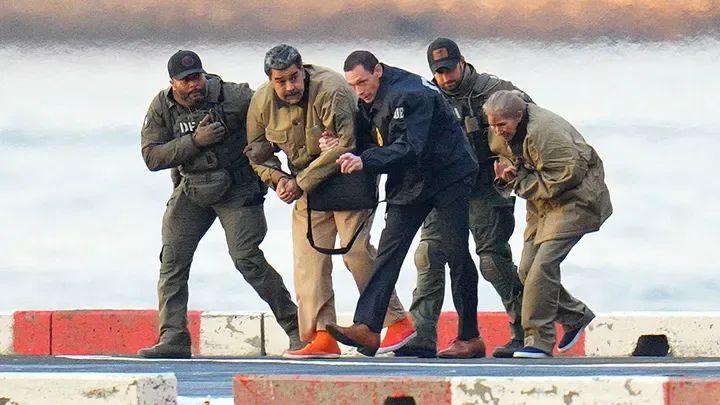
It marks a stunning escalation in U.S.-Venezuela relations and has sent shockwaves through the international community, with critics warning it sets a dangerous precedent that could reshape global power dynamics.
The Official Justification: Drugs and Democracy
Trump administration officials presented multiple rationales for the unprecedented military action.
The primary justification centered on combating drug trafficking, with Trump characterizing Venezuela under Maduro as a “narco-state” that posed a direct threat to American lives.
The Justice Department had indicted Maduro in March 2020 on cocaine-trafficking conspiracy charges, allegations he consistently denied.
In the months leading to the operation, the Trump administration designated two Venezuelan drug gangs as Foreign Terrorist Organizations, including the Cartel of the Suns, which officials alleged was led by Maduro himself.
Related: What Trump’s Travel Ban Means For Nigerians
Trump claimed that Venezuelan drug shipments were responsible for tens of thousands of American overdose deaths, though experts have disputed the scope of Venezuela’s role in drug trafficking to the United States.
Since September 2025, U.S. forces had struck at least 32 vessels in the Caribbean and Eastern Pacific, killing approximately 115 people, in what Trump described as an “armed conflict” with drug cartels.
Secretary of State Marco Rubio emphasized that the operation was designed to bring Maduro to justice while protecting American citizens.
Trump framed the action as fulfilling campaign promises to get tough on drugs flowing across America’s borders.
The Economic Incentive: Oil and Resources
Beyond the drug trafficking narrative, Trump made no secret of his interest in Venezuela’s vast natural resources.
The South American nation holds some of the world’s largest proven oil reserves, along with significant deposits of gold and rare earth minerals.
“We’re going to run the country,” Trump declared at his news conference, adding that American oil companies would invest billions to modernize Venezuela’s oil infrastructure.
He claimed the operation “won’t cost us anything” because U.S. companies would profit from selling Venezuelan oil to other nations.
Trump’s interest in Venezuelan oil predates his second term. In 2023, he stated Venezuela “was about to collapse. We would have taken over it and kept all that oil.”
Venezuelan opposition leader María Corina Machado had promised during a November 2025 business meeting attended by Trump to open Venezuela’s oil and gas reserves.
Analysts noted this represented a return to what some characterized as “resource imperialism.” The Maduro government had reportedly attempted to offer the U.S. access to these minerals in a failed effort to prevent military action.
The Military Operation: Months in the Making
The operation, designated “Absolute Resolve,” required extensive planning and coordination across multiple U.S. agencies.
Chairman of the Joint Chiefs of Staff General Dan Caine revealed that 150 aircraft were deployed from 20 different bases on land and sea, with intelligence agencies and law enforcement playing crucial roles.
The military buildup had been visible for months. U.S. forces massed in waters off South America, Trinidad and Tobago signed an agreement allowing U.S. military access to its airports, and the Coast Guard’s Deployable Specialized Forces conducted tactical boardings of oil tankers carrying Venezuelan crude in December 2025.
The CIA had also launched covert operations in late December, including a drone strike at a docking area allegedly used by Venezuelan drug cartels.
Trump announced on January 2 that the military would conduct strikes inside Venezuela, though the full scope of the operation caught many by surprise.
The assault itself lasted less than 30 minutes. U.S. forces turned off “almost all of the lights” in Caracas during the extraction.
At least seven explosions were heard across the capital, with smoke rising from military installations. Venezuelan Vice President Delcy Rodríguez stated that some Venezuelan civilians and military personnel were killed, though she did not provide specific numbers.
Trump reported that some U.S. forces were injured but none killed.
The Legal Questions: Gray Areas and Violations
The operation’s legality remains hotly contested. The Trump administration did not seek congressional authorization before launching the strikes, departing from recent precedent.
Under federal law, eight bipartisan senior members of Congress should receive prior notice of particularly sensitive covert actions, but no lawmakers appear to have been notified in advance.
House Minority Leader Hakeem Jeffries characterized the operation as “an act of war” that required explicit congressional approval.
Democratic lawmakers have called for legislative action to prevent further military steps without congressional authorization.
Virginia Senator Tim Kaine had previously pursued legislation to prohibit the use of federal funds for military force in or against Venezuela without congressional authorization, though those efforts proved fruitless.
The Trump administration defended its authority by arguing the president can take targeted military action to support U.S. interests without congressional authorization, provided it doesn’t result in “prolonged and substantial military engagements.”
Secretary of State Rubio insisted “this wasn’t an invasion” but rather a targeted operation to capture an indicted criminal.
International law experts were less equivocal, arguing the operation clearly violated international law.
United Nations Secretary-General António Guterres said he was “deeply alarmed” by the strikes, with spokesperson Stéphane Dujarric stating the developments “constitute a dangerous precedent” and noting that “the rules of international law have not been respected.”
Legal scholars drew parallels to the 1989 invasion of Panama to capture Manuel Noriega, though analysts noted significant differences in the international context.
While Noriega eventually spent 20 years in prison, the broader geopolitical landscape was markedly different in 1989, with a more stable rules-based international order.
International Reaction: Condemnation and Calculation
The global response to the operation split largely along geopolitical lines, with traditional U.S. adversaries condemning the action and some allies offering tepid support or carefully worded statements.
Strong Condemnation
Latin American leaders closest to Venezuela reacted with anger. Brazil’s President Luiz Inácio Lula da Silva condemned the capture as crossing “an unacceptable line” and called for a “vigorous” response from the United Nations.
“Attacking countries, in flagrant violation of international law, is the first step toward a world of violence, chaos, and instability, where the law of the strongest prevails over multilateralism,” Lula wrote.
Colombia’s President Gustavo Petro deployed security forces along the Venezuelan border to prepare for a potential refugee influx and rejected the “aggression against the sovereignty of Venezuela and of Latin America.”
Mexico condemned what it called a “clear violation” of international law, while Cuba’s President Miguel Díaz-Canel labeled the action “state terrorism.”
China and Russia both strongly opposed the operation. China’s foreign ministry said it was “deeply shocked” by Washington’s “blatant use of force” and called the action a serious violation of international law that threatened peace in Latin America.
Russia’s Foreign Ministry called it a “grave violation of sovereignty and international law” and warned it marked an “unacceptable assault” on Venezuela’s sovereignty.
Iranian officials condemned the strikes, with Supreme Leader commentary emphasizing that “the law of the strongest” was being imposed on weaker nations.
Cautious Western Response
U.S. allies in Europe offered more measured reactions. British Prime Minister Keir Starmer said his country “shed no tears about the end of Maduro’s regime” but reiterated support for international law and said Britain would discuss the situation with U.S. counterparts.
French officials criticized the military operation as violating international law principles while welcoming the end of Maduro’s rule.
German Chancellor Friedrich Merz described the legality as “complex” while warning against political instability.
Danish Foreign Minister Lars Løkke Rasmussen, whose country had been on the receiving end of Trump’s territorial ambitions regarding Greenland, issued a notably muted response calling for de-escalation and respect for international law.
Latin American Division
Not all Latin American leaders condemned the operation. Trump allies in the region expressed support: Argentina’s President Javier Milei celebrated with his signature slogan “Long live freedom, damn it!”; Ecuador’s President Daniel Noboa called it a blow to “narco Chavista criminals”; and El Salvador’s Nayib Bukele signaled support via social media.
Venezuelans themselves were divided. In Doral, Florida, near Miami, Venezuelan expatriates celebrated in the streets.
Similar celebrations occurred in Chile and other countries with large Venezuelan diaspora populations.
In Venezuela itself, pro-Maduro supporters took to the streets in protest, burning American flags, while others quietly hoped for change.
What Comes Next: Running a Country
Trump’s declaration that the United States would “run” Venezuela until a “safe, proper and judicious transition” raises profound questions about America’s long-term plans.
The Trump administration offered few details about governance structures or transition timelines.
Venezuelan Vice President Delcy Rodríguez, who reportedly fled to Russia after the strikes, had declared Maduro the country’s “only president” and demanded his release.
Defense Minister Vladimir Padrino López, who survived the strikes and commands Venezuela’s armed forces, holds significant sway over the country’s future.
Many speculate the U.S. negotiated a deal with key regime figures not to resist Maduro’s arrest, potentially leaving much of the regime structure intact.
Trump’s dismissive comments about opposition leader María Corina Machado—who won the 2025 Nobel Peace Prize for her fight for democracy and has a 72 percent approval rating among Venezuelans—shocked observers.
He suggested he would “have to look” at whether she could lead Venezuela, despite her being the heroic figure of the democratic opposition.
This raised concerns that Trump might cut a deal with remnants of the Maduro regime rather than empowering the democratic opposition.
The situation draws uncomfortable parallels to Iraq, where different advisers supported invasion for different reasons while obscuring post-invasion risks.
Experts warn that occupying Venezuela presents significantly greater challenges than the relatively swift Panama operation.
The Broader Context: A New Doctrine
The Venezuela operation fits into a broader pattern of Trump administration foreign policy that has alarmed both adversaries and allies.
Beyond Venezuela, Trump has revived ambitions to acquire Greenland from Denmark, threatened military action against various countries, and conducted strikes in seven nations—Iran, Nigeria, Yemen, Iraq, Syria, Somalia, and Venezuela—in less than 12 months of his second term.
This represents a dramatic shift for a president who campaigned on ending “endless wars” and criticized neoconservative nation-building.
The Trump administration’s proclaimed corollary to the Monroe Doctrine apparently assumes the U.S. can act as it wishes in the Western Hemisphere.
Analysts warn the operation sets dangerous precedents. Qatar’s Professor Sultan Barakat argued the U.S. actions could influence China’s approach to Taiwan and encourage Vladimir Putin to adopt a more aggressive stance toward Ukraine.
Indian analyst Brahma Chellaney noted that while the legal framing resembles the 1989 Panama invasion, the methodology aligns more closely with the 2003 Iraq invasion.
International law experts emphasized that seizing a leader by military force in what is now described as “a lawless world” opens a Pandora’s Box.
Trump did not create this world alone, but he has used American power to, in the words of Brookings analysts, “throttle what remained of international law and norms.”
Economic and Humanitarian Concerns
The operation’s immediate economic impact was muted. Venezuela produces little oil, accounting for less than one percent of global production, and 2026 production is forecast to exceed demand.
Weekend oil trading saw minor price rises, though prices declined after Maduro’s arrival in the United States.
The humanitarian situation is more complex. Trump administration officials claimed the operation would ultimately benefit Venezuelans by removing a dictator and modernizing infrastructure.
However, concerns about civilian casualties, refugee flows, and political instability loom large.
The administration also moved to end Temporary Protected Status for Venezuelans in the United States in 2025, meaning thousands could face deportation unless protections are reinstated.
Florida Representative Maxwell Higgins argued these individuals have built lives in America and deserve protection amid the chaos in their homeland.
Political Calculations at Home
Domestically, the operation presents both opportunities and risks for Trump. Republicans largely rallied behind the action, framing it as tough on drugs and crime.
Defense Secretary Pete Hegseth defended the operation as “the exact opposite” of Iraq, claiming the U.S. would gain economic benefits without spending American blood.
Democrats face a political dilemma. While they object to the lack of congressional authorization and potential violations of international law, Trump and Republicans are adept at framing opposition as defending drug dealers and dictators.
Political analysts note that Democrats’ electoral success has come from focusing on the economy and cost of living, not foreign policy disputes over international norms.
The operation also reignites debates about presidential war powers and the extent of executive authority in foreign policy.
Trump faces virtually no institutional check on his foreign policy decisions in his second term, with loyalists throughout his administration and a Supreme Court that has avoided war powers issues.
A Defining Moment
The invasion of Venezuela and capture of Nicolás Maduro may prove to be one of the defining moments of Trump’s second term—a dramatic demonstration of American power that reshapes the Western Hemisphere and potentially the broader international order.
Whether it represents a successful strike against drug trafficking and dictatorship or a dangerous precedent that erodes international law will be debated for years to come.
What is clear is that the world watches nervously as the United States embarks on running a country of nearly 30 million people, with few concrete plans and diminishing respect for the international norms that have governed relations between nations since World War II.
As Trump himself put it, “We’re going to run the country.” What that means in practice—for Venezuelans, for Americans, and for the future of international order—remains to be seen.
 Iran’s New Supreme Leader Calls On US And Israel To Pay “Blood Money”
  Why Atiku, Obi, David Mark, Amaechi Led ADC Protest To INEC Headquarters
  Trump, Iran Strike Two-Week Ceasefire Deal To Reopen Strait Of Hormuz
  Kwibuka 32: Rwanda Marks 32 Years Since The Genocide Against The Tutsi
  93-Year-Old Cameroonian President, Biya, Appoints Son As Vice President
  Tinubu’s Jos Visit Sparks Debate Over Airport Meeting With Attack Victims