
![Donald Trump, the US President, displays a signed founding charter for the Board of Peace at the World Economic Forum in Davos, Switzerland, on January 22, 2026 [AFP]](https://www.lionscrib.com/wp-content/uploads/2026/01/image-23.webp)
Donald Trump, the US President, displays a signed founding charter for the Board of Peace at the World Economic Forum in Davos, Switzerland, on January 22, 2026 [AFP]
DAVOS, Switzerland — President Donald Trump formally launched his “Board of Peace” on Thursday at the World Economic Forum in Davos, unveiling an international body he claims will resolve global conflicts—but the initiative has sparked division among world leaders and raised concerns about its scope and purpose.
From Gaza Reconstruction to Global Ambitions
The Board of Peace was first announced in September as a key component of the Trump administration’s 20-point plan for long-term peace in Gaza and the broader Middle East.
The United Nations Security Council endorsed the concept in November 2025 as part of efforts to oversee Gaza’s reconstruction following the devastating Israel-Hamas war.
However, the board has evolved significantly since its initial proposal. The organisation’s 11-page charter does not mention Gaza once, instead outlining a sweeping mandate to promote global stability and resolve conflicts worldwide.
Trump suggested Thursday the board could expand beyond the Middle East. “I think we can spread out to other things as we succeed with Gaza,” Trump said.
“Once the board is formed we can do pretty much whatever we want to do”.
Trump as Permanent Chairman
The board’s structure has raised eyebrows among international observers. Donald Trump is explicitly named in the charter as its inaugural Chairman with no term limit, and he alone has the authority to nominate his designated successor and invite countries to join.
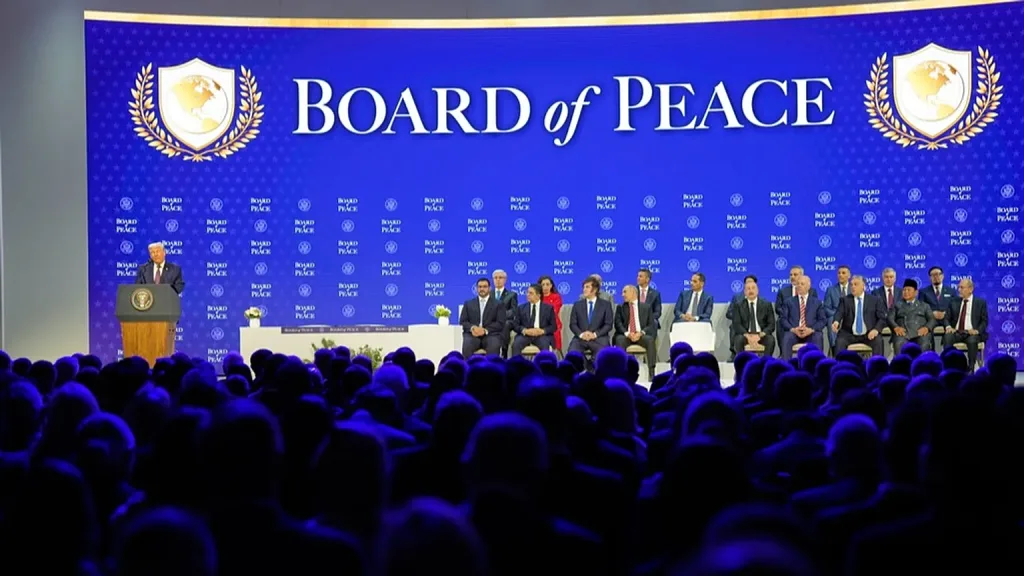
The founding executive council includes Secretary of State Marco Rubio, Trump’s special envoy Steve Witkoff, Trump’s son-in-law Jared Kushner, former British Prime Minister Tony Blair and World Bank President Ajay Banga.
Countries seeking permanent membership face a steep price tag: a $1 billion contribution, though the White House has characterized this as voluntary.
Who’s In, Who’s Out
More than 30 countries have accepted invitations to join the board, but the roster reveals notable absences.
Leaders from 17 countries signed the founding charter alongside Trump in Davos, including representatives from Argentina, Turkey, Hungary, Bulgaria, Bahrain, Kazakhstan, Kosovo, Qatar, Armenia, Azerbaijan, Morocco, Paraguay and Pakistan.
Regional Middle Eastern powers including Egypt, Jordan, the United Arab Emirates, Indonesia, Saudi Arabia, Israel and Kuwait have also agreed to participate.
Notably, Israeli Prime Minister Benjamin Netanyahu accepted Trump’s invitation despite earlier concerns about the board’s composition.
But major U.S. allies have declined or expressed reservations. British Foreign Secretary Yvette Cooper said the UK opted out of signing on Thursday, joining France, Norway, Sweden and Slovenia in refusing to participate. Germany and Italy have remained noncommittal.
“We won’t be one of the signatories today,” Cooper told the BBC Thursday.
“Because this is about a legal treaty that raises much broader issues, and we do also have concerns about President Putin being part of something which is talking about peace.”
Controversial Invitations
Trump’s invitation to Russian President Vladimir Putin has proven particularly contentious. Putin was “studying all the details of this proposal,” Kremlin Spokesman Dmitry Peskov said, but no representative was present at the signing event.
Russian state media reported Putin was considering a $1 billion contribution.
Belarus President Aleksandr Lukashenko, whose country has supported Russia’s invasion of Ukraine, accepted an invitation to join.
In a dramatic turn Thursday night, Trump withdrew Canada’s invitation after Canadian Prime Minister Mark Carney delivered a speech at Davos criticizing great powers using “tariffs as leverage” and “supply chains as vulnerabilities to be exploited”—remarks seen as directed at Trump’s policies.
Trump also threatened France with 200% tariffs on wine and champagne after the country declined to join, calling the board’s charter incompatible with UN principles.
Criticism and Concerns
The initiative has drawn sharp criticism from international relations experts and some European leaders. The Guardian described it as a “pay-to-play club” centered on Donald Trump, and critics have called it “a fledgling club of autocrats” and a vanity project.
David Wearing, a lecturer in international relations at the University of Sussex, told Al Jazeera the board was “clearly an attempt to render the UN obsolete” and position Trump “in a kind of monarchical or imperial position”.
France voiced concern that the board seeks to usurp the United Nations’ role, while multiple European ambassadors have raised doubts about its legal framework and compatibility with the UN charter.
What’s Next
Trump insisted Thursday the board would work alongside the United Nations, though he previously suggested it “might” replace the international body.
“I think the board of peace will be the most prestigious board ever, and it’s going to get a lot of work done that the United Nations should have done,” Trump said Wednesday.
Secretary of State Marco Rubio indicated that membership would likely grow, noting that some countries need to complete internal procedures before joining.
It remains unclear what criteria the White House is using to determine invitations, and whether any countries have agreed to pay the $1 billion for permanent membership.
As the board begins its work, questions persist about its actual authority, its relationship with existing diplomatic institutions, and whether it will focus on Gaza reconstruction or pursue Trump’s broader global ambitions.
 Nigeria Besieged By Terror While Tinubu, APC Focused On Stealing Power In 2027— Obi
  Iran Appoints Mojtaba Khamenei As Supreme Leader Following Father’s Death
  Guinea Disbands 40 Political Parties, Including Key Opposition Groups
  After the Ayatollah: Reckoning with the Ramifications of America’s War on Iran
  Tiwa Savage Launches Foundation To Support African Music Creatives
  Gunmen Kidnap Six Church Members In Ondo State