
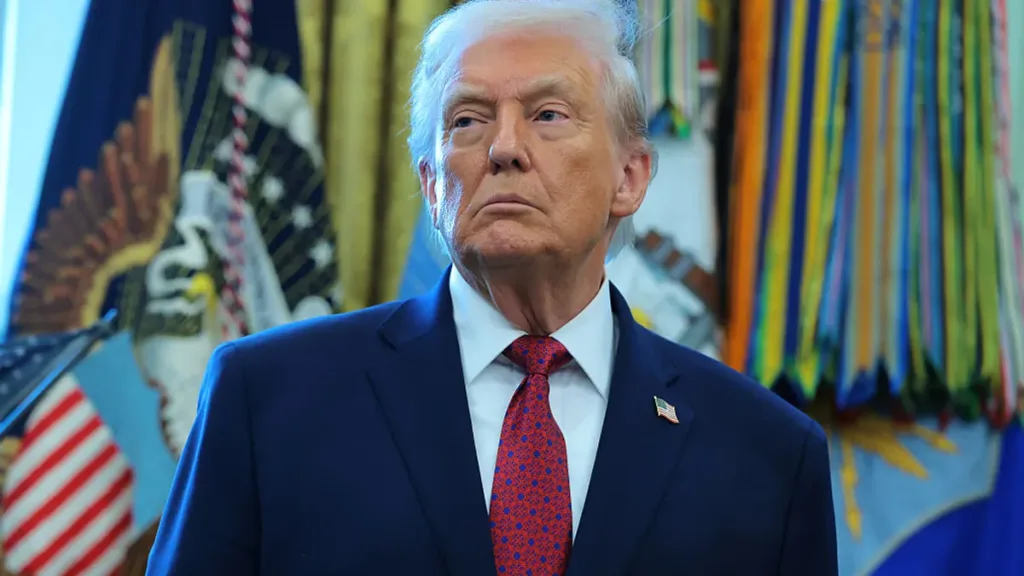
President Donald Trump at the White House's Oval Office on December 15, 2025, in Washington, DC. Photo by Anna Moneymaker/Staff via Getty Images
Trump’s new travel ban is expected to have a significant impact on Nigerian travellers from January 1, 2026.
Nigerian citizens seeking to travel to the United States now face significant new restrictions after President Donald Trump expanded his controversial travel ban this week, adding Africa’s most populous nation to a list of countries whose nationals face partial entry limitations.
The White House announced Tuesday that Nigeria would be among 15 countries facing partial restrictions on entry for immigrants and holders of B-1, B-2, B-1/B-2, F, M, and J visas, effective January 1, 2026. The move doubles the number of countries affected by Trump’s travel restrictions to 39 nations worldwide.
What Visas Are Affected?
The new restriction bars entry for Nigerians seeking to enter the US as green card holders, or on B‑1, B‑2, B‑1/B‑2, F, M, and J visas.
In practical terms, this means Nigerians holding visas for business travel, tourism, combined business and tourism, academic studies, vocational or nonacademic studies, and exchange programs are now barred from entering the United States under the new restrictions.
The proclamation also directs consular officers in Nigeria to reduce the validity period for other nonimmigrant visas issued to Nigerian nationals.
Why Nigeria Was Included
The Trump administration cited multiple justifications for including Nigeria on the restricted list. The White House noted that radical Islamic terrorist groups such as Boko Haram and the Islamic State operate freely in certain parts of Nigeria, creating substantial screening and vetting difficulties.
Additionally, Nigeria recorded a B-1/B-2 visa overstay rate of 5.56 per cent, while the overstay rate for F, M, and J visas stood at 11.90 per cent, according to the U.S. Department of Homeland Security’s fiscal year 2024 report.
The administration broadly claimed that many restricted countries suffer from widespread corruption, fraudulent or unreliable civil documents and criminal records, and nonexistent birth-registration systems that prevent accurate vetting.
Who Is Exempt?
Not all Nigerians are affected by the new restrictions. Exemptions apply to lawful permanent residents already in the United States, individuals who already hold valid visas, diplomatic visa holders, athletes competing in major events, and certain special immigrant visa categories.
The proclamation also allows for case-by-case exceptions when entry is deemed to serve U.S. national interests.
Broader Context
The latest expansion builds on a travel ban Trump first reinstated in June 2025, which initially affected 19 countries. The new proclamation adds seven countries to the full travel ban list while imposing partial restrictions on 15 others, with Africa bearing the brunt of the expanded measures.
Twelve of the 15 countries that face partial restrictions are in Africa, including Angola, Benin, Ivory Coast, Gabon, Gambia, Malawi, Mauritania, Nigeria, Senegal, Tanzania, Zambia and Zimbabwe.
The timing of the ban’s expansion coincides with a shooting incident in Washington, D.C., involving an Afghan national who killed one National Guard member and critically wounded another over Thanksgiving weekend. The administration has cited this incident as justification for tightening immigration controls.
Diplomatic Tensions
The restrictions come weeks after the U.S. designated Nigeria a “Country of Particular Concern” over allegations that the Nigerian government supports Islamic extremists persecuting Christians. The Nigerian government denied these accusations, characterizing the country’s security challenges as more complex than portrayed.
Recent diplomatic engagements between the two countries have addressed these concerns. On Monday, U.S. Ambassador to Nigeria Richard Mills met with Foreign Minister Yusuf Tuggar to discuss areas of mutual concern, though the travel ban announcement came just one day later.
Muted Reactions
Reactions on the African continent were largely muted on Wednesday as affected nations mulled the implications of the measure and their next moves. Countries newly added to the restricted list said they were evaluating the news and reaching out to U.S. officials for clarification.
Related: UK Vows To Stick With Its Travel Ban Despite Threat Of Retaliation By FG
Some analysts warn that the measures could strain U.S.-Africa relations. Beverly Ochieng, an analyst at Control Risks Group, predicted that the travel ban will likely make relations between the U.S. and various African countries unpredictable and challenging, potentially pushing some governments to seek stronger partnerships elsewhere.
Impact on Nigerian Travelers
Nigeria has historically maintained strong ties with the United States, with thousands of Nigerians traveling annually for education, business, and tourism. The restrictions are expected to significantly impact Nigerian students, business travelers, and families with relatives in the United States.
Critics of the ban argue that it unfairly targets entire populations rather than addressing security concerns through individualized, evidence-based screening. Advocacy organizations have described the expansion as using security language to justify blanket exclusions that punish families, students, workers, and people with longstanding ties to the United States.
The proclamation represents a significant expansion of the travel restrictions Trump first implemented during his previous term in office, which primarily targeted Muslim-majority countries and were reversed by President Joe Biden in 2021. The current version is broader and more punitive, affecting a wider range of countries and visa categories.
As the restrictions take effect in January, Nigerian travelers and those with pending visa applications will need to closely monitor guidance from U.S. consular offices for specific information about how the new rules will be implemented.
 Ghana’s Opposition Takes To The Streets, Warns Democracy Is “Under Attack”
  Concern Mounts In Cameroon Over 93-Year-Old President Biya’s Prolonged Absence
  U.S. Makes Visa Bond Rule Permanent, Sweeping In 30 African Nations
  Tinubu Says Government Won’t Pay Ransom Or Bargain With Kidnappers, Terrorists
  US Unleashes “Heavy Wave” Of Strikes On Iran Following Missile Attack On American Troops
  INEC Is Impartial, Says Tinubu
  Actor Timini Egbuson Opens Up On Borrowing To Maintain Extravagant Lifestyle