
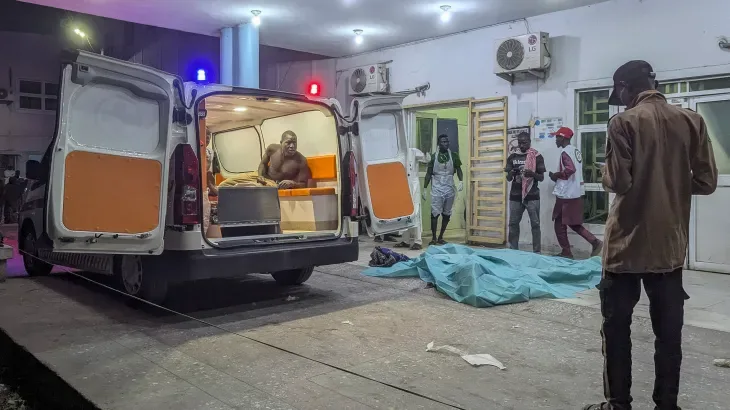
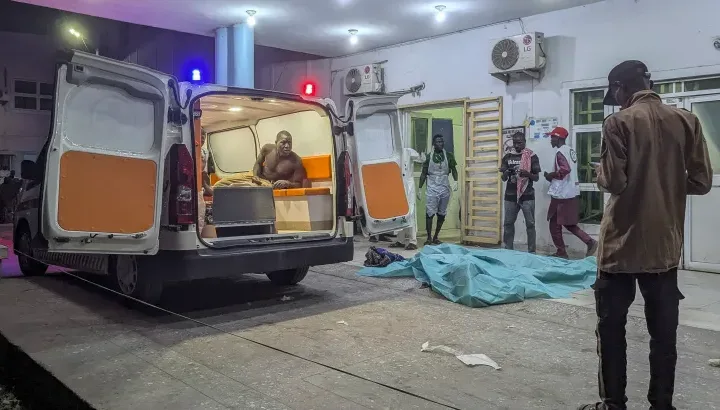
An ambulance carrying victims of the Maiduguri bombings arrives the hospital/Lionscrib News
Series of suicide bombings claimed at least 23 lives in Maiduguri on Monday night.
At least 23 people have been killed and more than 100 others wounded in a series of suspected suicide bombings that struck Maiduguri, the capital of Borno State, on Monday night.
Authorities confirmed the death toll on Tuesday, describing the incident as one of the worst attacks the city has seen in years.
What Happened
Multiple blasts struck three locations in the city on Monday, prompting police to deploy explosives clearance teams.
The targeted sites included the entrance of the University of Maiduguri Teaching Hospital and two busy local markets — the Post Office Market and Monday Market — according to Sirajo Abdullahi, head of operations at the National Emergency Management Agency (NEMA) in Maiduguri.
By Tuesday morning, heavy security had been deployed in the affected locations and along major roads in the city.
Many public places remained closed amid heightened fear.
What Police Are Saying
Borno State police spokesperson Nahum Kenneth Daso confirmed in a statement that 23 persons lost their lives while 108 others sustained varying degrees of injuries, and attributed the attacks to suspected suicide bombers.
Related: Seven Soldiers Were Ambushed And Killed By Boko Haram In Borno State
He added that “investigations are ongoing to further ascertain the circumstances surrounding the incidents and to bring perpetrators to justice.”
Eyewitness Accounts
The scale of the carnage was captured in harrowing accounts from those on the ground.
Bagoni Alkali, who witnessed one of the blasts, said he transported wounded people to the hospital for emergency treatment, adding that many people lost their lives at the scene immediately after the explosion.
Mohammed Hassan, a member of a volunteer group that assists security forces in the conflict, said he evacuated 10 bodies from the markets, with several more victims dying at the hospital.
“This attack has been one of the deadliest in Maiduguri in years,” he said, adding that the city was in urgent need of blood donations.
The Wider Security Context
The bombings occurred less than 24 hours after the Nigerian military repelled an attack by militants on the outskirts of Maiduguri — a sequence that some residents believe may have been a deliberate distraction.
Extremists have intensified their attacks against Nigerian military bases in recent weeks, killing several senior officers and soldiers and stripping bases of weapons and ammunition.
Monday’s bombings are being seen by some analysts as a significant symbolic blow, given that Maiduguri has long been regarded as impregnable, with past attacks largely confined to troops and villages on the city’s outskirts.
Maiduguri had been relatively calm in recent years, with attacks peaking in the mid-2010s.
The last major assault on the city dated back to 2021, when Boko Haram fighters fired mortars, killing 10 people.
However, in December, an unclaimed bombing killed at least seven people in a city mosque.
Official Reactions
Borno State Governor Babagana Zulum condemned the bombings and suggested the recent surge in attacks is connected to intensified military operations in the Sambisa Forest, a known stronghold of armed groups in the region.
“The act is utterly condemnable, barbaric and inhumane,” he said.
President Bola Tinubu, who departed for a two-day state visit to the United Kingdom on Tuesday, expressed condolences to the victims’ families and directed security agencies to respond.
The Nigeria Governors’ Forum also condemned the attacks, with its Chairman describing the bombings as a reckless waste of human lives and calling on security agencies to degrade the capacity of terrorists to carry out such attacks.
Who Is Responsible?
No group has yet claimed responsibility for the attacks. However, the pattern of the bombings — targeting crowded civilian areas in Borno State — is consistent with tactics historically associated with Boko Haram and its splinter faction, the Islamic State West Africa Province (ISWAP), both of which remain active in the Lake Chad Basin region.
 Israel Reportedly Injures New Iranian Leader During Airstrike
  Senegal Doubles Penalty For Gay Sex To 10 Years
  Iran Threatens To Eliminate Trump
  Federal Government Set To Introduce Social Media Age Limits
  Nigeria Besieged By Terror While Tinubu, APC Focused On Stealing Power In 2027— Obi
  Iran Appoints Mojtaba Khamenei As Supreme Leader Following Father’s Death
  What We Know About The Suicide Bombings In Maiduguri
  Oscars 2026: Complete List Of Winners And Nominees
  Popular Comedian Broda Shaggi Reportedly Shot And Hospitalised