
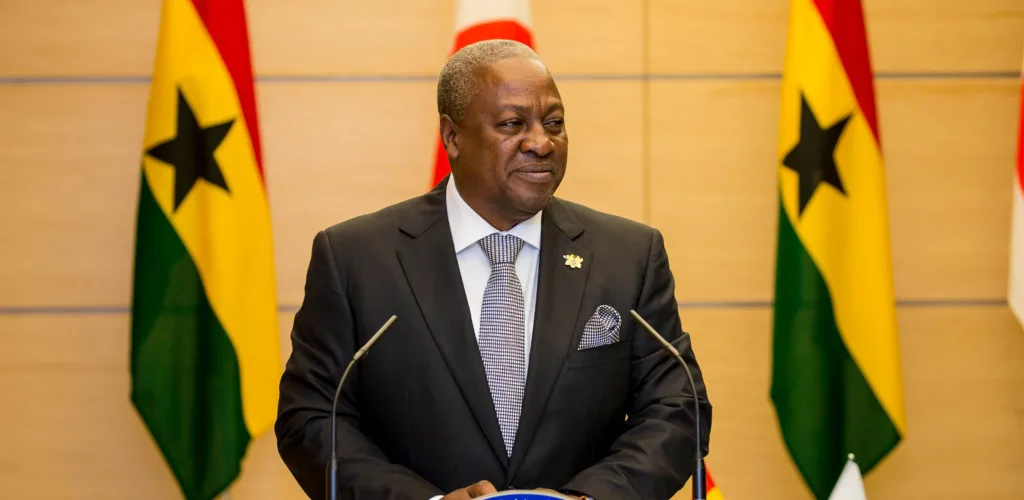
President Mahama believes Nigeria is strategic to Ghanaian interest/Lionscrib News
President Mahama says Nigeria is vital to Ghana’s security and stability.
Ghana’s President John Mahama has made a candid and striking statement about Nigeria, revealing that he prays daily for Nigeria, Africa’s most populous nation to stabilise and prosper so that millions of Nigerians do not end up migrating to his comparatively smaller country.
Speaking at an award ceremony, President Mahama expressed his deep concern about the ripple effects that Nigeria’s economic and political challenges have on the broader West African region, particularly Ghana.
He was frank and unapologetic in his assessment, framing Nigeria’s wellbeing not just as a neighbourly wish but as a matter of direct national interest for Ghana.
Mahama’s Comments Spark Conversation
The Ghanaian President’s remarks have stirred considerable conversation across West Africa, touching on issues of migration, regional stability, economic governance, and the delicate interdependence between neighbouring nations.
While his words were laced with humour, the underlying message carried significant weight: Nigeria’s internal struggles do not stay within Nigeria’s borders — they spill over, and Ghana feels the effects.
“Nigeria is of keen security interest to us. If Nigeria does well, Ghana does well,” President Mahama said.
“I mean, when you have cousins, 250 million of them, you want them to do well so that one million of them don’t come drifting towards a small country like Ghana.
“So every day when I wake up, I pray for Nigeria — ‘God let Nigeria get their acts together.”
The statement was immediately received with a mixture of laughter, applause, and sober reflection — a reaction that reflects just how layered and complex the Nigeria-Ghana relationship truly is.
Nigeria and Ghana: A Long and Complex Relationship
The relationship between Nigeria and Ghana is one of the most storied in all of Africa. Both countries share deep historical, cultural, and ethnic ties that predate colonial borders.
The two nations have maintained a relationship that oscillates between rivalry and solidarity, competition and cooperation — sometimes within the same decade.
Historically, Ghana was among the first sub-Saharan African nations to gain independence, doing so in 1957 under the iconic Kwame Nkrumah. Nigeria followed in 1960.
In the years that followed, both countries jostled for regional influence, economic dominance, and political prestige.
Ghana, at one point, was wealthier per capita than Nigeria and was widely regarded as the beacon of African democracy and good governance.
However, Nigeria’s oil boom in the 1970s shifted the balance considerably.
The sudden wealth that flowed into Nigeria made it the dominant economic force in West Africa — a status it has largely maintained, even as that wealth has been poorly distributed and often plundered by corrupt leadership.
Related: Ghana Hits Israel With Matching Deportations
Today, Nigeria accounts for the largest share of the Economic Community of West African States (ECOWAS) GDP, making it a critical pillar of regional economic stability.
This history makes President Mahama’s statement all the more layered.
He is not speaking from a position of indifference — he is speaking as a leader who understands, perhaps better than most, just how closely tied Ghana’s fortunes are to Nigeria’s performance.
The Migration Question: Why It Matters
At the heart of Mahama’s statement lies a question that is becoming increasingly urgent across Africa: what happens when large numbers of people flee struggling nations and head toward more stable ones?
Nigeria, despite its enormous size and vast natural resources, has struggled for decades with systemic poverty, insecurity, corruption, and infrastructural decay.
Under the current administration of President Bola Tinubu, the country has been grappling with one of its worst economic crises in recent memory.
The removal of the fuel subsidy in 2023, the devaluation of the naira, skyrocketing inflation, and widespread unemployment have collectively pushed millions of Nigerians deeper into hardship.
In response, emigration — popularly referred to in Nigeria as the “Japa” phenomenon — has accelerated dramatically.
The term “Japa,” derived from Yoruba slang meaning to flee or escape, has come to define an entire generation of Nigerians who are leaving the country in search of better opportunities abroad.
Doctors, engineers, nurses, teachers, and young graduates are departing in alarming numbers, bound for the United Kingdom, Canada, the United States, and increasingly, other African nations.
Ghana, with its relatively stable democracy, stronger institutions, and more consistent governance record, has naturally become a destination of interest.
The country uses the English language, shares cultural similarities with Nigeria, and is geographically close — making it an accessible option for Nigerians looking to relocate within the continent.
Mahama’s acknowledgment of this trend is therefore not just diplomatic candour — it is a policy concern.
A sudden influx of migrants, regardless of how skilled or educated they may be, puts pressure on a host country’s housing, healthcare, employment market, and social services.
For a country the size of Ghana, absorbing large numbers from a country the size of Nigeria is not a trivial matter.
Regional Security: The Bigger Picture
Beyond migration, Mahama’s framing of Nigeria as a “keen security interest” is deeply significant.
Nigeria’s internal security challenges — from Boko Haram insurgency in the northeast, to banditry in the northwest, to separatist agitation in the southeast, to communal violence across the Middle Belt — have long threatened to destabilise the broader West African region.
The Lake Chad Basin, shared between Nigeria, Niger, Chad, and Cameroon, has been a hotbed of jihadist activity for over a decade, with Boko Haram and its splinter group, the Islamic State West Africa Province (ISWAP), conducting attacks across borders.
Nigeria’s ability — or inability — to contain these threats directly affects the security environment of every country in the sub-region.
Moreover, the recent wave of military coups in West Africa — in Mali, Burkina Faso, Guinea, and Niger — has created a volatile regional environment.
In this context, Nigeria’s stability as a democratic anchor becomes even more critical.
If Nigeria, with its size and influence, were to experience serious political destabilisation, the consequences for the entire region would be catastrophic.
Mahama is acutely aware of this. His prayer for Nigeria is therefore as much a strategic calculation as it is a neighbourly sentiment.
Ghana’s Own Economic Challenges
Interestingly, Mahama’s comments come at a time when Ghana itself has faced significant economic difficulties.
The country went through a severe economic crisis between 2022 and 2023, requiring a bailout from the International Monetary Fund (IMF).
Ghana defaulted on parts of its external debt and was forced to undertake a painful domestic debt restructuring programme, which wiped out significant value from the savings of many Ghanaians, including pensioners.
The crisis hit ordinary Ghanaians hard, causing the cedi to lose substantial value against major currencies and driving up the cost of living.
It was partly on the back of public frustration with this economic mismanagement under the previous Akufo-Addo administration that Mahama and his National Democratic Congress (NDC) party returned to power.
Mahama, who previously served as Ghana’s president from 2012 to 2017, won the December 2024 elections and was inaugurated for a second term in January 2025.
His return to power came with high expectations from Ghanaians who hoped he would steer the country out of its economic difficulties.
The irony, therefore, is not lost on observers: a president whose own country is working to recover from economic turbulence is simultaneously praying that an even larger neighbour does not collapse — because the consequences of that collapse would make Ghana’s own recovery even harder.
Nigeria’s Response and Public Reactions
Mahama’s remarks have generated significant buzz in Nigeria’s public discourse.
Reactions have ranged widely — from those who found his words humorous and refreshingly honest, to those who felt the statement was condescending or patronising.
Some Nigerians took to social media to joke about the comment, leaning into the self-deprecating humour embedded in the imagery of a million Nigerians drifting toward Ghana.
Others, however, expressed irritation, pointing out that Ghana has had its own fair share of economic struggles and is therefore not in a position to look down on Nigeria.
Yet many Nigerians, particularly those who have lived through the country’s ongoing hardships, acknowledged the truth in Mahama’s words.
The “Japa” wave is real. The desperation driving it is real. And the fact that even the president of a neighbouring country is publicly acknowledging it only underscores the urgency of Nigeria’s situation.
Political analysts in both countries have noted that Mahama’s statement, while made in a light-hearted setting, reflects a sincere concern that leaders across West Africa share privately but rarely express so openly in public.
The Broader Question of African Leadership
Mahama’s prayer for Nigeria also raises a broader question about leadership accountability on the African continent.
Nigeria is endowed with some of the most abundant human and natural resources in the world.
It sits atop vast oil reserves, has a massive agricultural base, a large and youthful population, and some of the most talented and entrepreneurial people on the planet.
Yet despite all of this, the country has consistently failed to convert its potential into widespread prosperity.
Decades of misrule, corruption, ethnic politics, and institutional weakness have hollowed out the Nigerian state, leaving millions in poverty and pushing its best minds to seek opportunities elsewhere.
For Ghana’s president to publicly say that he prays for Nigeria to “get their act together” is, in a sense, a reflection of a larger regional frustration — a frustration that a country with so much promise continues to underperform so dramatically.
The question of what it will take for Nigeria to truly turn the corner is one that has been asked for generations.
Some point to the need for structural reforms — diversifying the economy away from oil, investing in education and healthcare, strengthening institutions, and fighting corruption at the highest levels.
Others argue that the problem is more fundamental, rooted in the very nature of the Nigerian state as a colonial construct that has never managed to build genuine national cohesion.
What Nigeria Needs to Do
For Nigeria to fulfil its enormous potential and ease the migration pressures that concern leaders like Mahama, a number of urgent steps are widely recommended by economists and policy experts.
First, the government must take serious and sustained action to address insecurity.
The ongoing crisis of banditry, terrorism, and communal violence is not just a humanitarian disaster — it is an economic one.
Farmers cannot farm, businesses cannot operate, and investors will not invest in an environment of lawlessness and fear.
Second, the government must demonstrate a genuine commitment to fighting corruption.
Public funds must be transparently managed and visibly deployed toward infrastructure, healthcare, and education.
The culture of impunity that has allowed public officials to loot state resources for decades must be dismantled through strong institutions and consistent enforcement of the law.
Third, Nigeria must invest urgently and massively in its young people.
With over 60 percent of its population under the age of 25, Nigeria has a demographic dividend that could power its economy for decades — but only if those young people are educated, skilled, employed, and given reason to believe in the future of their country.
Fourth, the economic reforms currently being pursued must be accompanied by robust social safety nets.
The pain of subsidy removal and currency devaluation cannot be borne entirely by the poorest Nigerians while the wealthy continue to thrive.
Policy must be equitable, and its benefits must be felt at the grassroots.
Conclusion: A Neighbour’s Prayer
President Mahama’s words were delivered with a smile and received with laughter, but they carry a message that deserves serious reflection.
The fate of Nigeria is not just Nigeria’s business — it is the business of every country that shares a region, a coastline, or a border with it.
When Nigeria struggles, West Africa feels the tremors. When Nigeria’s people despair, its neighbours absorb the human consequences.
And when Nigeria fails to live up to its potential, the entire continent pays a price.
Mahama’s prayer is, in the end, a prayer that many across Africa share — quietly, sincerely, and with the full understanding of what is at stake.
Whether Nigeria’s leaders are listening is, as always, the more pressing question.
 Israel Votes In Crucial Election As Netanyahu Faces Tough Challenge To Retain Power
  Harry Kane Makes History As First Englishman To Win Ballon d’Or In 25 Years
  Nigeria’s First Ebola Patient Flown Overseas For Treatment
  Lula Wins Historic Fourth Term As Brazil’s President In Dramatic Election Victory
  France Mobilises 70,000 Officers As Protests Spread Across The Country
  First Lady Remi Tinubu Eyes 2031 Exit From Presidential Villa