
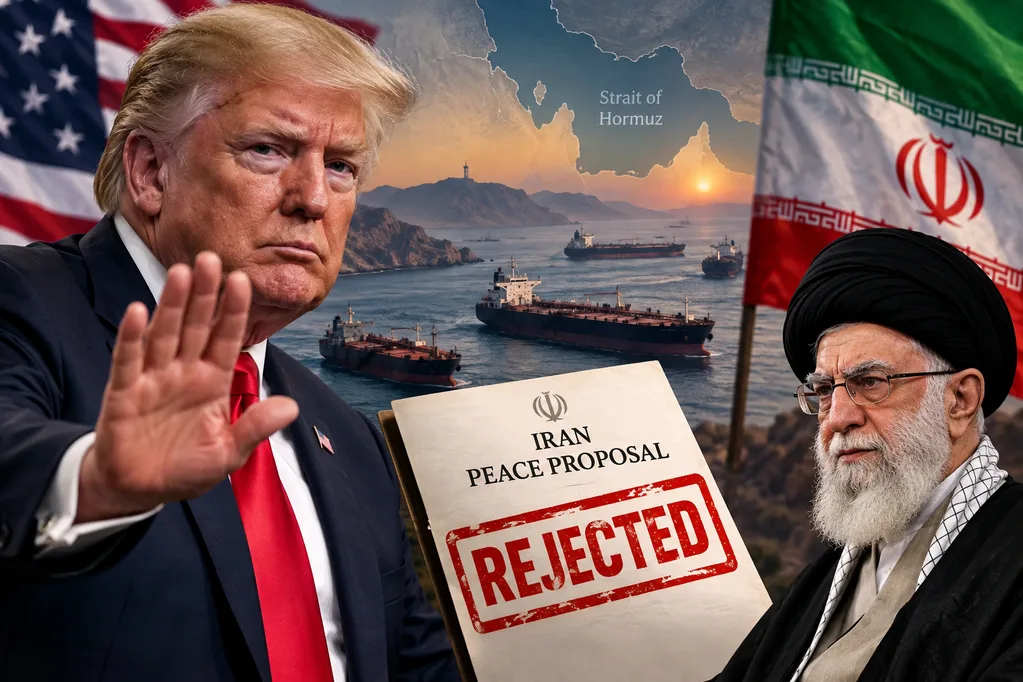
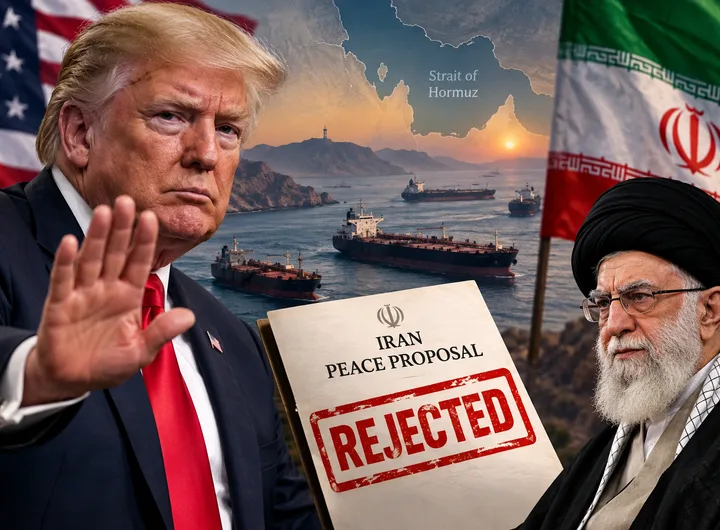
Trump rejected Iran's peace proposal outrightly
A new Iranian peace proposal has been rejected by President Donald Trump, leaving major disagreements between Washington and Tehran unresolved.
U.S. President Donald Trump has rejected Iran’s latest proposal aimed at ending months of conflict and reopening the Strait of Hormuz, arguing that Tehran’s terms did not go far enough to satisfy Washington’s demands.
The proposal was delivered to the United States through regional mediators following indirect negotiations in New York.
Iranian officials said the plan could lead to the reopening of the Strait of Hormuz and the resumption of broader peace negotiations within seven days.
The strategic waterway has become one of the biggest points of disagreement between the two countries.
Iran’s proposal reportedly called for the United States to lift its naval blockade on Iranian ports, ease restrictions affecting Iranian oil exports and support a wider regional ceasefire.
In exchange, Tehran would reopen the Strait of Hormuz and return to negotiations, including discussions surrounding its nuclear programme.
Trump, however, publicly rejected the proposal.
“They have made a proposal and I rejected it,” he told reporters on September 26.
One major reason for the disagreement appears to be the different priorities of the two sides.
Related: Israel Rejects Trump’s 15-Point Gaza Plan, Netanyahu Demands Full Hamas Disarmament
Iran wants negotiations to focus heavily on the Strait of Hormuz, sanctions and the U.S. naval blockade.
The Trump administration, meanwhile, wants Iran to make significant concessions regarding its nuclear programme before Washington agrees to major economic or military concessions.
Trump has also argued that the United States currently has greater leverage in the negotiations.
Speaking about Iran’s proposal, he claimed Tehran wanted an agreement because it was suffering economically and strategically from the conflict and U.S. pressure.
Washington’s blockade has restricted Iranian oil exports, while sanctions have continued to place pressure on Iran’s economy.
Control of the Strait of Hormuz remains another major obstacle. Iran has maintained that previous understandings with Washington gave it a significant role in controlling passage through the waterway.
The United States and several regional allies have rejected that interpretation, insisting on freedom of navigation.
The strait is particularly important because roughly one-fifth to one-quarter of the world’s oil normally passes through it, meaning disruptions can quickly affect global energy prices.
Despite Trump’s rejection, diplomatic efforts have not completely collapsed. Mediators, including Qatar, have continued indirect discussions between Washington and Tehran.
Iranian officials have also said they remain willing to negotiate, while U.S. officials have described some recent mediated discussions as constructive.
For now, the disagreement is less about whether negotiations should happen and more about what each side must give up to make them possible.
Iran is seeking sanctions relief, an end to the blockade and guarantees concerning regional military action.
Washington is pushing for stronger nuclear concessions and fewer Iranian restrictions on navigation through the Strait of Hormuz.
Until those differences narrow, a lasting agreement between the two countries remains difficult to achieve.
 At Least 27 Dead in Two Separate Mass Shootings in South Africa
  Trump Defends Iran War, Targets ICC In 2026 UN General Assembly Speech
  President Tinubu Extends Working Vacation
  37 Suspected Illegal Miners Die In NSCDC Custody
 ![US President Donald Trump and Canadian Prime Minister Mark Carney pictured during their May 6 meeting at the Oval Office in Washington, DC [Evan Vucci/AP Photo]](https://www.lionscrib.com/wp-content/uploads/2026/09/image-12-e1789635717373-720x410.webp) Trump Warns EU Of ‘Serious Tariffs’ Over Canada Associate Membership Plan
Trump Warns EU Of ‘Serious Tariffs’ Over Canada Associate Membership Plan  South African President Cytril Ramaphosa Falls Sicks After BRICS Summit
  Why Trump Rejected Iran’s Peace Proposal