
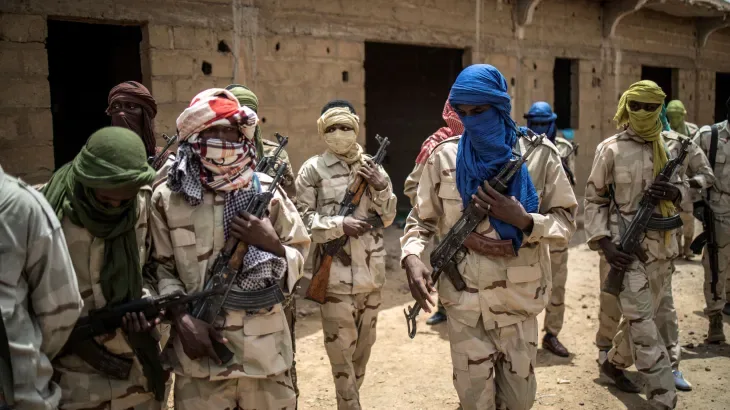
Terror groups are reported to have taken over strategic areas in Mali/Photo: Screenshot Aljazeera
Mali is on the brink of collapse following coordinated attacks by terror organizations in key cities.
The West African nation of Mali has been plunged into its most severe security crisis in years following a wave of coordinated attacks launched on Saturday, April 25, 2026, that struck multiple cities simultaneously, from the capital, Bamako, to northern strongholds, exposing alarming vulnerabilities in the country’s military government.
Heavy gunfire and explosions rocked Mali’s capital and other key cities in what has been described as one of the most significant coordinated attacks in recent years, as armed groups exploited worsening insecurity in the Sahel region.
A Deadly Morning
Two loud explosions and sustained gunfire were reported shortly before 6 a.m. GMT near Mali’s main military base in Kati, just north of Bamako.
Soldiers were deployed to block roads. There was similar unrest at around the same time in the central town of Sévaré, and in Kidal and Gao in the north.
The al-Qaeda-linked group Jama’at Nusrat al-Islam wal-Muslimin (JNIM) claimed responsibility for attacks carried out in Kati near the capital, as well as at Bamako’s airport and other locations further north, including Mopti, Sévaré and Gao.
Tuareg rebels also claimed participation in the assault.
The death toll among the country’s top leadership was swift and devastating.
Mali’s Defence Minister, Gen. Sadio Camara, was killed in a bombing at his home in Kati.
He died alongside his second wife and two grandchildren when a suicide bomber drove a car into his residence.
A key figure in the ruling military junta and widely regarded as a future leader, Camara’s death sent shockwaves through the government.
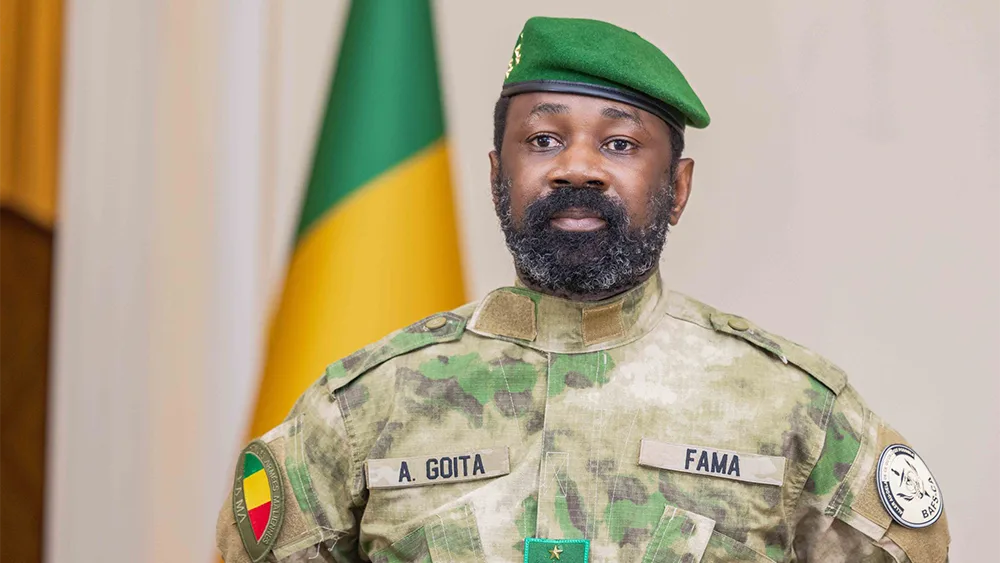
Other senior officials, including military ruler Gen. Assimi Goïta, were reported to have gone into hiding.
An Unprecedented Scale
Analysts have described the operation as extraordinary in both its reach and organisation.
Al Jazeera’s Nicolas Haque, who has extensively reported from Mali, said the scale and coordination of the attacks “appear to be unprecedented,” adding that “there is an unprecedented level of panic” in the military ranks.
Mathias Hounkpe, the International Foundation for Electoral Systems’ country director for Mali, told Al Jazeera: “If they were able to cover almost the whole country in one day, it means there are security vulnerabilities in the system. They have also been able to reach the city of Kati, where the president and other important ministers live, that is the centre of power.”
Notably, the attacks marked a rare alliance between two armed factions with differing ideologies.
Analyst Bulama Bukarti noted that the two groups had previously been fighting each other but came together last year with an agreement to work against their common enemy, the Malian state and that the April attacks represent the implementation of that agreement.
A Crisis Years in the Making
Mali’s descent into instability did not happen overnight.
In August 2020, military officers led by Gen. Goïta seized power in a coup d’état, forming a military junta that pledged to improve security.
The government later broke ties with France, the former colonial power, and expelled the UN peacekeeping mission MINUSMA, which completed its withdrawal in 2023.
Mali’s junta subsequently turned to Russian-backed mercenaries from the Wagner Group, now rebranded as Africa Corps, to address the country’s worsening insecurity.
These forces have been accused by the UN of waging a “climate of terror and complete impunity.”
However, even that alliance has shown cracks.
Al Jazeera reported that, because of pressure on the Russia-Ukraine front, some Russian mercenaries are being withdrawn from Mali, which is directly affecting the security situation on the ground.
The Broader Sahel Crisis
Mali’s turmoil does not exist in isolation. The country remains part of a broader regional grouping alongside Burkina Faso and Niger, all three ruled by military juntas that came to power through coups.
According to this year’s Global Terrorism Index, the Sahel region remains the epicentre of terrorist activity worldwide and accounted for more than half of all terrorism-related deaths in 2025.
UN Secretary-General António Guterres said he was “deeply concerned” over the attacks, strongly condemning the violence and expressing solidarity with the Malian people while stressing the need to protect civilians and civilian infrastructure.
UN humanitarian operations in Mali are currently targeting support for around 3.8 million people, out of more than five million in need.
What Next?
Ulf Laessing, a Sahel analyst at the German think tank Konrad Adenauer Stiftung, described the coordination between different armed groups as “a very dangerous development,” warning that since the crisis began in 2012, security has been “degrading” every year and the government has little control over large areas of the country.
For now, the Malian government insists it has the situation in hand. But with a Defence Minister dead, a military ruler in hiding, key northern cities contested, and two ideologically different armed groups fighting as one, the junta’s grip on power faces its most serious test yet, and the people of Mali are caught in the crossfire.
 Israel Votes In Crucial Election As Netanyahu Faces Tough Challenge To Retain Power
  Harry Kane Makes History As First Englishman To Win Ballon d’Or In 25 Years
  Nigeria’s First Ebola Patient Flown Overseas For Treatment
  Lula Wins Historic Fourth Term As Brazil’s President In Dramatic Election Victory
  France Mobilises 70,000 Officers As Protests Spread Across The Country
  First Lady Remi Tinubu Eyes 2031 Exit From Presidential Villa