
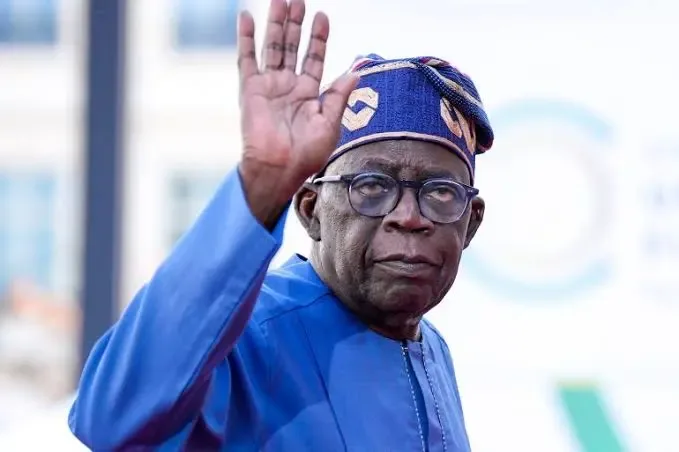
Tinubu/Photo: AFP
President Bola Tinubu has restated that his government will not pay ransom or negotiate with kidnappers, terrorists, or other armed criminal groups, insisting Nigeria would not free jailed gang members in exchange for abducted victims.
President Bola Ahmed Tinubu again made clear on Thursday that his administration has no intention of negotiating with kidnappers, terrorists, and other violent criminal networks, stating that Nigeria will not hand over ransom money or release jailed criminals to secure the freedom of abduction victims.
The president also revealed that the gang behind the kidnapping of schoolchildren and teachers in Oyo State had asked for both cash and the release of jailed members of their group, demands his government flatly turned down.
Tinubu made these remarks while hosting traditional rulers from Oyo State, headed by the Olubadan of Ibadanland, Oba Rashidi Ladoja, at the State House in Abuja.
This statement comes as the federal government pushes harder to tackle the kidnapping, banditry, and terrorism crises that have troubled large parts of Nigeria for the past ten years.
While past administrations have all officially opposed paying ransom, mass abductions remain among the country’s most pressing security threats, with armed groups increasingly targeting schools, roads, and rural areas.
Kidnapping-for-ransom has grown from scattered criminal acts into a business worth billions of naira, especially in the North-west and North-central regions, where well-armed groups based in expansive forest zones have repeatedly seized students, travelers, monarchs, and farmers.
Security analysts have consistently pointed out that paying ransom only fuels more kidnappings by funding weapons purchases and the recruitment of new fighters.
“We refuse to negotiate with criminals,” President Tinubu said.
“They wanted us to release members of their criminal gangs already in detention in addition to demanding money, but we said no deal.
“We will not negotiate with murderers and terrorists,” he emphasised.
This is one of the clearest instances yet in which the government has confirmed that certain kidnapping networks are now pushing for prisoner swaps alongside ransom demands, a strategy typically linked to terrorist organizations.
Related: Rescue Or Negotiated Release? Questions Trail Freedom of Abducted Oyo Pupils, Teachers
Tinubu credited the effectiveness of Nigeria’s changing security approach for the successful rescue in Oyo State and praised the military and other security agencies for their courage and professionalism.
“I agree with you that we should commend the men and women of the Armed Forces for their excellent performance,” Tinubu continued.
“Every security operation teaches us new lessons, challenges us to review our security architecture, strategy and operational plans, and strengthens our resolve to defeat terrorism and banditry,” he said.
The president added that the federal government is overhauling the country’s security framework by growing the Nigerian Army from eight divisions to twelve, a move aimed at boosting operational reach and cutting down response times to threats nationwide.
This expansion is part of a wider push to fortify Nigeria’s security institutions as the country deals with a range of threats, terrorism in the North-east, banditry in the North-west, violent clashes in the North-central, separatist unrest in sections of the South-east, and growing kidnapping cases across several regions.
He also noted that the government is reinforcing local security systems by setting up state police forces with proper checks against misuse, while boosting the capabilities of forest guards to root out criminals hiding in forests and other unpoliced spaces.
The push for state police has long been a contentious topic in Nigeria’s security and constitutional conversations, with proponents saying decentralized policing would sharpen intelligence collection and cut response times, while opponents worry state governments could misuse the power.
Even so, Tinubu’s government has consistently backed the idea, maintaining that proper constitutional protections will be put in place.
“There will be state police, but with guardrails against abuse,” Tinubu assured.
“Traditional rulers will also have greater roles to play.
“We are equally enhancing the capacity of forest guards, not to chase animals, but to pursue criminals and deal decisively with them.”
The president went on to say that intelligence gathering remains a core part of the fight against insecurity, urging traditional rulers to encourage their communities to stay alert, watch for unusual activity, and quickly alert security agencies to suspicious individuals.
He pointed out that worsening instability in neighbouring Mali, Burkina Faso, and Niger Republic has driven up cross-border criminal activity, making it essential to tighten Nigeria’s border security, boost forest patrols, and deepen cooperation among security agencies.
Tinubu also disclosed that some of those involved in the Oriire abduction were foreign nationals, tying the incident to broader instability in the Sahel region, where coups, extremist violence, and weak border enforcement have driven the movement of armed groups across West Africa.
Security agencies have repeatedly cautioned that Nigeria’s weak border controls have allowed foreign fighters, illegal weapons, and cross-border criminal networks to infiltrate the country, particularly given the political turmoil across parts of the Sahel.
 Trump Accused Of Bribery Over $5,000 Pledge To Voters
  Dangote Refinery Set To Launch Major IPO To Fuel Capacity Expansion
  Dominican Republic’s Joheirry Mola Crowned Miss World 2026
  Duane “Keffe D” Davis Found Guilty in Tupac Shakur Murder Case Nearly 30 Years Later
  Niger’s Capital Settles Back Into Routine After Attempted Military Coup
  Atiku Slams Tinubu Over Vacation Amid Nigeria’s Security And Economic Woes
  Davido Slams Erigga Over Comments About Musicians From Poor Backgrounds