
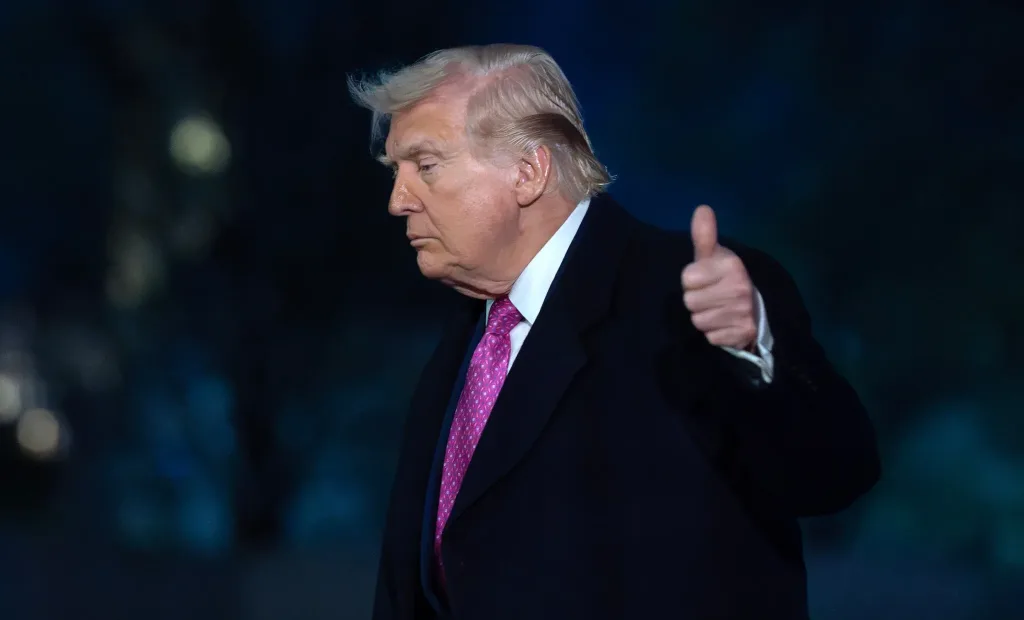
Trump is said to be considering ending hostilities with Iran after weeks of war/Getty Images
Trump has signalled readiness to end Iran conflict despite Strait of Hormuz remaining shut.
US President Donald Trump has told his advisors privately that he is prepared to bring the US-Iran war to a close even if the Strait of Hormuz remains shut, the Wall Street Journal reported Monday, citing administration officials.
Trump and his team have concluded in recent days that any attempt to reopen the strategic chokepoint would drag the conflict well beyond his intended four-to-six-week timeline.
The closure of the critical waterway has sent oil prices surging to their highest level in nearly four years, with Brent crude trading at $113 per barrel today — a 56% jump from prices before the US-Israeli military campaign against Iran began.
According to the report, Trump wants the US to concentrate on its core objectives — degrading Iran’s naval capabilities and depleting its missile arsenals — before winding down hostilities.
The plan involves applying diplomatic pressure on Tehran to restore normal trade flows through the strait.
Should that approach fail, officials indicated that Washington would call on European and Gulf allies to take the lead in reopening the waterway.
On Sunday, Trump threatened to “obliterate” Iranian energy infrastructure, including Kharg Island — Iran’s principal oil export terminal in the Persian Gulf — if Tehran fails to agree to a peace deal “shortly.”
In the same Truth Social post, Trump also claimed that negotiations toward ending the war with a “NEW, AND MORE REASONABLE, REGIME” were making “great progress.”
The post was consistent with what has become a familiar pattern of contradictory statements from the president regarding the war’s status.
A US pullback from the conflict could ease regional tensions and improve prospects for the strait’s reopening, a route whose disruption has been a key driver of rising global oil prices.
Bloomberg separately reported that nearly all vessels now transiting the strait are following Iran-approved corridors — hugging the Iranian coastline rather than the Omani side — and many are doing so only after negotiating safe passage directly with Iranian authorities.
Malaysia and Thailand have also announced individual agreements to secure the release of tankers that had been stranded in the Gulf.
 From Lagos to Paris: How Street Model Rachel Ojuromi Made Her Chanel Runway Debut
  Badenoch Hits Out At Reform In Fiery Conference Speech Amid ‘Englishness’ Row
  France Rocked By Nationwide Student Protests Over Education Crisis
  Tinubu Announces Three-Day National Mourning For Air Force Personnel Killed In Plane Crash
  Brazil’s Presidential Election Heads To A Runoff
  Tinubu’s 2026 Independence Day Speech: From Reform To Prosperity, But Nigerians Await The Results